The Faculty of Law at Universitas Tanjungpura engages in various research programs and academic initiatives that contribute to the development of legal knowledge across diverse fields and disciplines. These activities provide students with meaningful opportunities to participate in research and practical learning experiences, as well as to collaborate closely with faculty members on projects aligned with their academic and professional interests.
Governance and Management Structure
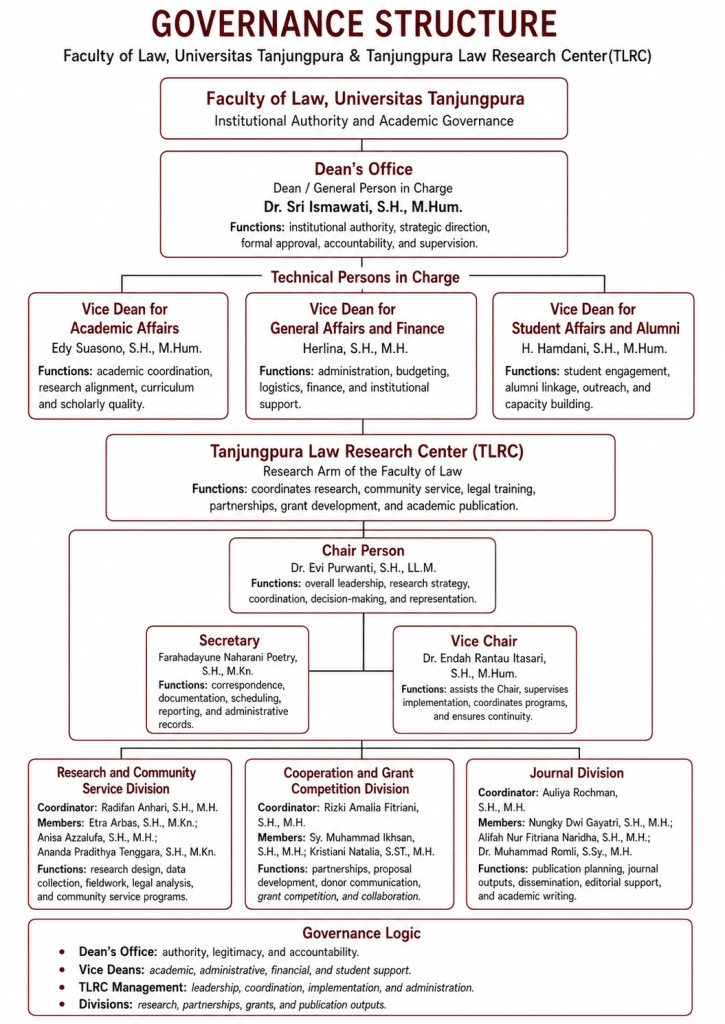
A central component within the governance structure of the Faculty of Law, Universitas Tanjungpura is the Tanjungpura Law Research Center (TLRC). TLRC is formally established as a faculty-based research center under the authority of the Dean of the Faculty of Law. Its establishment is intended to strengthen research, community service, legal education and training, academic development, international networking, stakeholder collaboration, and the Faculty’s competitiveness in research grant schemes. The Dean’s Decree concerning TLRC mandates the Center to develop stakeholder networks, design and implement research, community service, and legal training activities, and disseminate the results of such activities independently or in collaboration with external partners.
Institutionally, TLRC operates as the research arm of the Faculty of Law, Universitas Tanjungpura. It connects the strategic authority of the Dean’s Office with the technical implementation of research, grant management, publication development, stakeholder engagement, and academic capacity building. This governance relationship ensures that TLRC is not merely an ad hoc research group, but a formally recognized faculty center with clear leadership, accountability, and functional divisions.
The governance of TLRC is directly linked to the Dean’s Office. The General Person in Charge is Dr. Sri Ismawati, S.H., M.Hum., Dean of the Faculty of Law, Universitas Tanjungpura. The Technical Persons in Charge consist of the Vice Deans, namely Edy Suasono, S.H., M.Hum., Vice Dean for Academic Affairs; Herlina, S.H., M.H., Vice Dean for General Affairs and Finance; and H. Hamdani, S.H., M.Hum., Vice Dean for Student Affairs and Alumni. This arrangement places TLRC within a strong faculty-level supervision system, ensuring that its programs are aligned with academic priorities, administrative procedures, financial accountability, student development, and institutional cooperation.
At the operational level, TLRC is managed by an executive team led by Dr. Evi Purwanti, S.H., LL.M. as Chair, assisted by Dr. Endah Rantau Itasari, S.H., M.Hum. as Vice Chair, and Farahadayune Naharani Poetry, S.H., M.Kn. as Secretary. This leadership composition provides the academic and managerial foundation for coordinating research programs, legal training, grant-based activities, institutional collaboration, and scholarly dissemination.
TLRC is further supported by three functional divisions. The Research and Community Service Division is coordinated by Radifan Anhari, S.H., M.H., with members Etra Arbas, S.H., M.Kn., Anisa Azzaulfa, S.H., M.H., and Ananda Pradhitya Tenggara, S.H., M.Kn. This division strengthens TLRC’s capacity to design and implement empirical, doctrinal, socio-legal, and community-oriented research. It supports research planning, fieldwork, data collection, legal analysis, stakeholder consultation, community service programs, and the preparation of research reports.
The Cooperation and Grant Competition Division is coordinated by Rizki Amalia Fitriani, S.H., M.H., with members Sy. Muhammad Ikhsan, S.H., M.H., Kristiani Natalia, S.ST., M.H., and Andi Tri Utami Hasyim, S.H., M.Kn. This division is particularly strategic for international grant purposes because it supports partnership development, proposal preparation, donor communication, grant competition, collaborative program planning, legal documentation, and external stakeholder engagement. Its presence demonstrates that TLRC has a dedicated institutional mechanism for expanding research cooperation and competing in national and international funding schemes.
The Journal Division is coordinated by Auliya Rochman, S.H., M.H., with members Nungky Dwi Gayatri, S.H., M.H., Alifah Nur Fitriana Naridha, S.H., M.H., and Dr. Muhammad Romli, S.Sy., M.H. This division strengthens TLRC’s ability to transform research activities into academic outputs, including journal articles, policy papers, proceedings, research briefs, edited volumes, and other publication-oriented products. For international grant implementation, this division ensures that project activities produce measurable scholarly and policy-relevant outputs.
Accordingly, TLRC offers a complete governance model for international grant implementation. The Dean’s Office provides institutional authority, legitimacy, supervision, and accountability. The Vice Deans provide technical support in academic affairs, finance and administration, student affairs, and alumni engagement. The TLRC executive team coordinates day-to-day implementation, while its functional divisions ensure that research, community service, cooperation, grant competition, legal documentation, and publication outputs are managed through dedicated working units.
This structure gives the Faculty of Law, Universitas Tanjungpura a strong institutional advantage in international grant collaboration. Through TLRC, the Faculty can offer international partners a research center that is formally recognized, directly accountable to the Dean, supported by faculty leadership, and equipped with specialized divisions for research, grant cooperation, stakeholder engagement, legal documentation, and academic publication.
Vision
To become a leading faculty-based legal research center that advances evidence-based legal research, inclusive digital participation, online safety, digital legal literacy, and trustworthy internet governance, in alignment with Universitas Tanjungpura’s direction toward becoming a cyber university and the Internet Society Foundation’s commitment to an open, secure, globally connected, trustworthy, and people-centered Internet.
Mission
- To conduct legal and socio-legal research on internet-related issues, including trustworthy internet use, online safety, digital rights, digital legal literacy, cyber vulnerability, online fraud, misinformation, digital consumer protection, and platform-related risks.
- To support Universitas Tanjungpura’s cyber university direction by strengthening legal research, policy analysis, digital literacy, and community-based legal education related to the use, governance, safety, and protection of digital environments.
- To strengthen community capacity in using the Internet safely, openly, inclusively, and responsibly through research-based legal education, public engagement, training, workshops, and digital literacy programs.
- To support evidence-based policy development on internet governance, online safety, digital rights protection, consumer protection in digital transactions, platform accountability, misinformation, and community protection from online harms.
- To promote inclusive internet participation by engaging students, communities, civil society organizations, public institutions, and vulnerable groups in research, education, and capacity-building activities.
- To build national and international research networks with universities, research institutions, civil society organizations, government agencies, internet governance actors, donor institutions, and other strategic partners.
- To improve the Faculty of Law’s competitiveness in national and international grant schemes through structured proposal development, collaborative research, project implementation, reporting, monitoring, evaluation, and dissemination.
- To disseminate research findings through academic publications, policy briefs, public reports, stakeholder forums, workshops, webinars, legal literacy materials, and community-oriented knowledge products.
- To strengthen the contribution of the Faculty of Law, Universitas Tanjungpura to open, secure, globally connected, trustworthy, and people-centered Internet development, particularly in West Kalimantan, borderland communities, and the wider Southeast Asian region.